Jeff interviews Brett: Transcript
You know, I’ve been going to the Kruger Park every single year since.
Even now, I live next to the Kruger Park.
I take my own kids there on on vacation.
You know, can I remember I’ve got a few memories, but older, of certain places that we were going to that really sparked and ignited this.
You know, I knew by the by the age of 16, I wanted to to go into the bush, as we call it, but at at actually at that stage, I I thought I would go more into the conservation side or what we call a game ranger.
You know, I was super inspired by reading these stories.
Cousin was a guide.
Uncle was running a lodge in in Zimbabwe, Lake Kariba, we used to go there a lot.
Uh I have like very serious memory of being in Zim and they gave me this book, "A Guide's Guide to Guiding".
And and you know, at that stage, it was like enjoy your career, but I was still quite young.
And you know, that was one of the signs.
I go back when I look at that book, I’m like, "Wow, you know that that path was already there."
Uh I remember going to a lodge in Timbavati.
I was 16-17.
My My folks actually, you know, we went there at that time to like try and spend time with the guide, my dad knew the owner of the lodge and like really see, "Hey, you know now I’m 16, what how do you get to be doing what these guys are doing?"
Anyway, I I got distracted a bit, but I there was another book called "Tails of a Game Ranger" which was which was section rangers in Kruger National Park who were looking after the animals, the roads.
Not really involved in looking after tourists on a daily basis, more looking after the problems that tourists make.
And and I felt I was going to get into that.
I then did a guide training course with Eco Training in Karongwe in in 2004, and that I still figured I that was my first year out of school, I was trying to figure out what to study in order to go into the conservation or more management side, and I was under the mentorship of of a guy, Mike Cawdon, at the time.
He was working at Southern Cross, I was working at Southern Cross, and he was a guide and he had this huge influence and he talked to me about his years of guiding.
And I went out with him a few times and then I just thought, "I actually, you know, maybe I do want to look after people, and maybe I do want to drive these these Land Rovers around."
Yeah.
And then, that was in 2005 I started guiding.
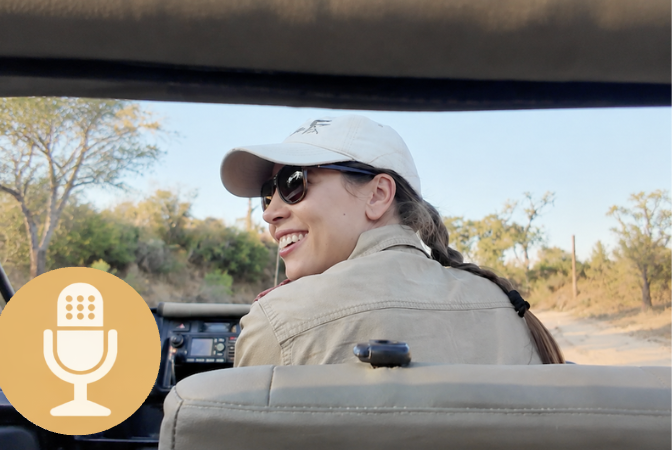
Welcome to Campfire Conversations, a podcast brought to you straight from the African bush by BHS.
I'm Brett, your host, and I have the great pleasure of talking to some true legends and icons in the field of safari and conservation.
Most of these chats happen around a campfire or under a setting African sun.
And this iconic scene of safari is exactly what inspired these conversations to begin with.
If you can, put your feet up, pour a drink, and feel inspired and entertained by the characters you'll meet here around our virtual shared campfire.
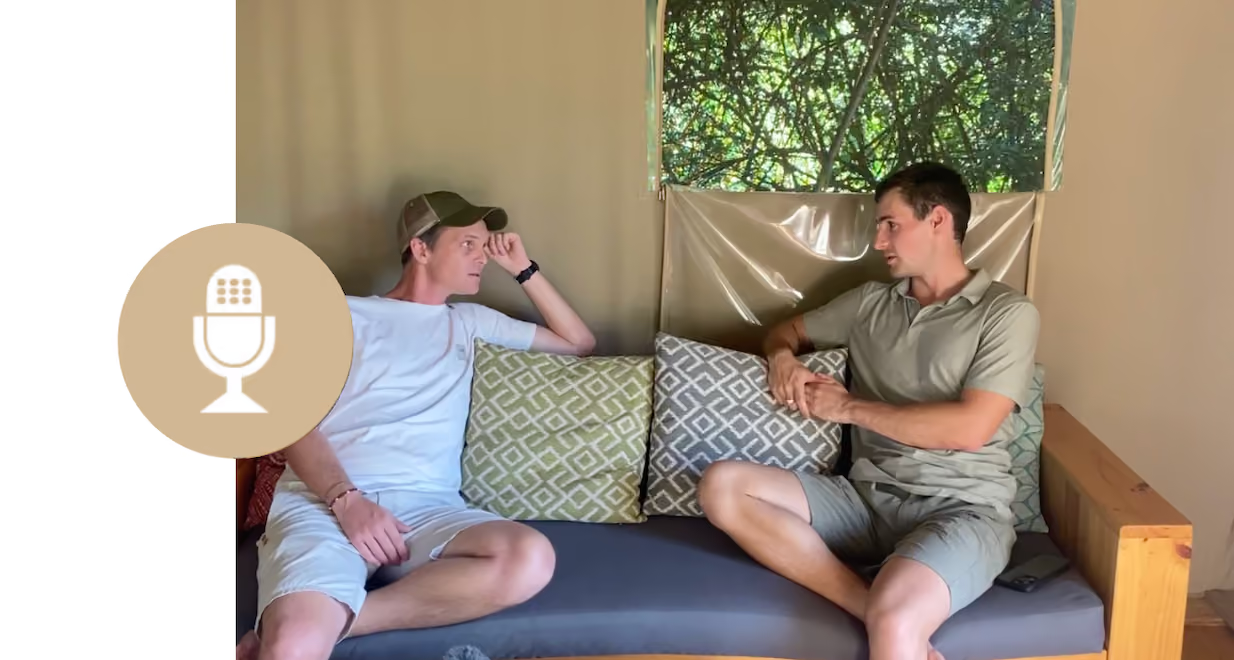
Hello, everyone.
Welcome back for an all-new episode of Campfire Conversations with Brett Horley.
Now, your first question right off the bat is probably, "Who's speaking right now?
Who is this?
This isn't Brett Horley."
This is Jeff Hyer speaking, and I'm very excited to be hosting today's episode.
But don't you worry, we still have the man, the myth, the legend himself, Brett Horley is still here.
We're going to do something a little bit different today.
Role reversal.
I'm putting him in the hot seat, going to ask him some questions because now's our chance to get to know Brett better.
All right?
Cuz you're you're usually interviewing other people and getting to know them.
So, thanks for being willing to be vulnerable in the hot seat today and letting me interview you.
So, before I get to that, who am I?
I am Jeff Hyer, a safari travel advisor.
I produce a lot of safari insight videos, as well as safari vlogs—lighthearted material which allows people to become more educated before they go on safari trips.
But if they don't have the chance to go on safari themselves, it's a chance for them to follow along for the adventures virtually.
And so, that's something I love.
If you're interested to follow my adventures, check me out at Jeff Hyer, j-e-f-f_h-y-e-r.
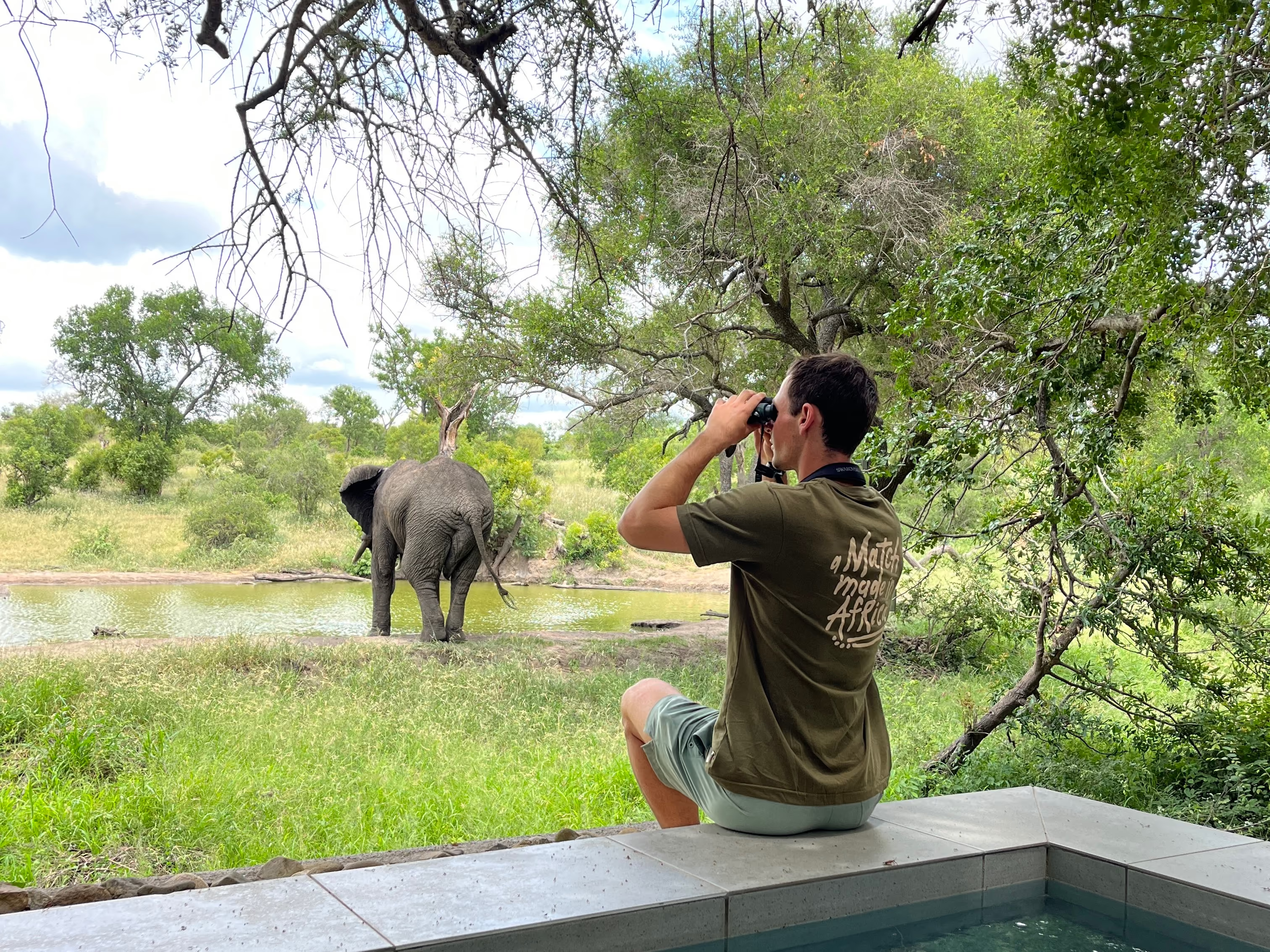
So, if you're following the channel, you'll see that I was recently on a BHS safari.
I'm posting a lot of content from my recent trip.
It has been a wonderful experience, and it's all because of the BHS team.
So, that's what leads me to where I am today.
I am interviewing Brett Horley, the fearless leader of BHS, uh to get to know him better.
And this is a chance for me not only to learn more about his story but pick his brain for his safari expertise.
So, Brett, are you ready?
Introducing today's guest, everyone!
I don't know if I'm ready.
Thank you, Jeff.
Thank you so much, man.
Of course.
Thanks for having me.
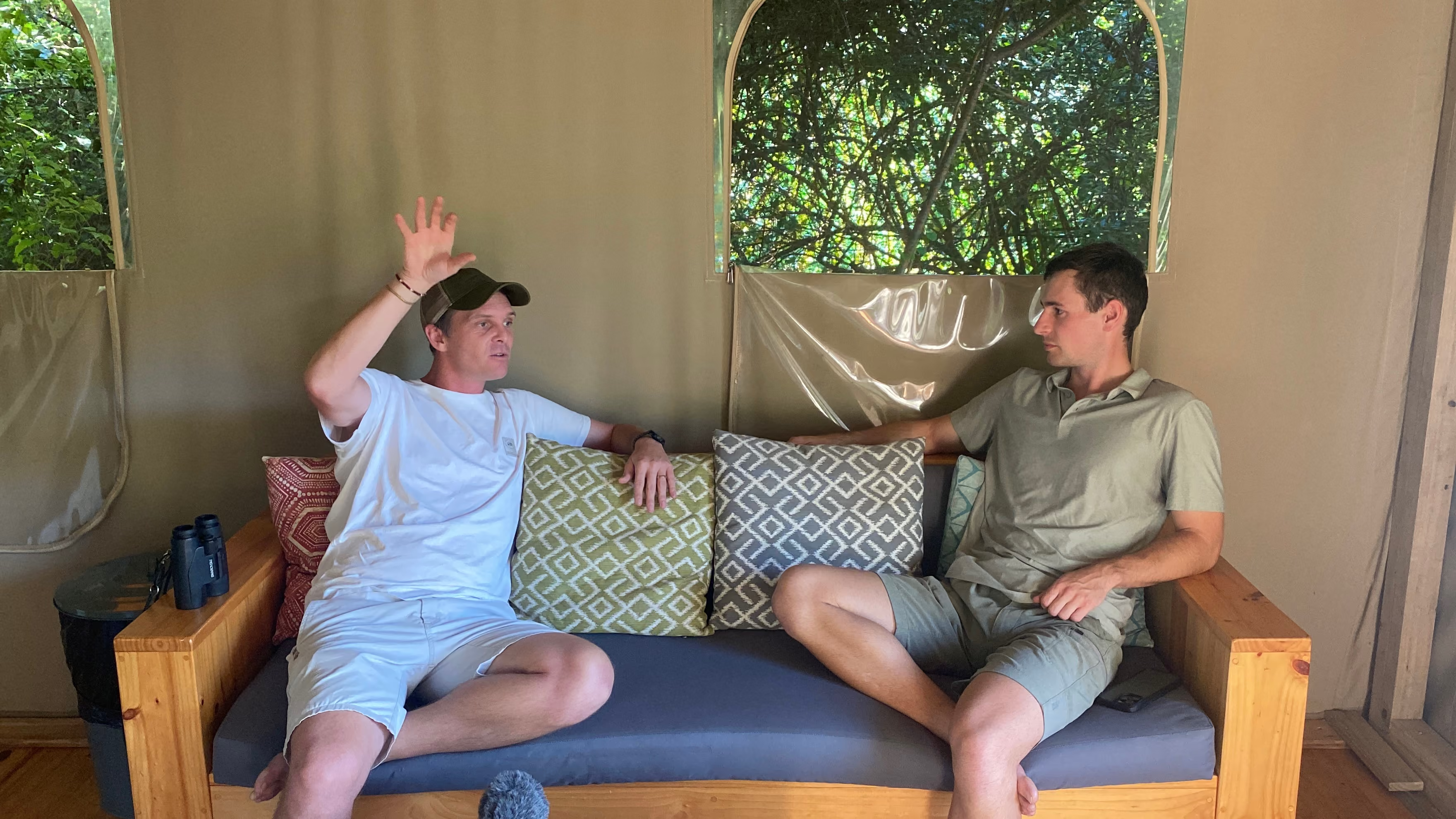
So, where are we right now?
Cuz I can't pronounce it.
So, here we are in Magoebaskloof.
We're in Limpopo, we're about an hour to the west of Kruger National Park, but we're a thousand feet higher than the Kruger Park.
We're right on the edge of the Northern Drakensberg in a massive piece of pure pristine indigenous forest.
Wow.
We've come here to change temperature.
Yeah.
Yeah.
So, what are we all doing here besides cooling off a bit?
So, yeah, I mean, I just, once again, thanks so much for hosting this Campfire Conversation.
Super exciting.
We are we're here a couple of things.
One, you were actually the inspiration, so you're here on a kind of month, six-week long mega familiarization safari, and we are on a team retreat with our whole team.
Super cool.
We wanted to host you somewhere that we love and somewhere outside of the safari scene.
And twice a year we get away together as a team just to spend time away from the office and and try not talk about work, but we talk about work all the time.
Yeah.
So, spend time together with you and and and with our team.
Mhm.
So, thanks so much for having me along.
Being an extension of your team is an honor and I'm so excited that I get to appear on this podcast finally because the first way I discovered you, did you know, was through the podcast.
It was the first time I heard your voice.
You and Joe sat down and talked about Uganda?
Yes.
So, the fact I'm now sitting across from you in person, it's exciting.
It's exciting stuff.
Yeah, that's super cool.
Yeah.
So, anyway, you get to be the star of this episode.
We get to shine a spotlight on you.
Cuz I think our audience is curious to know more about you.
You've got a wealth of knowledge and expertise in safari travel, and a lot of people like me are curious like, who are you?
So, let's dive into your origin story a little bit.
Maybe some more basic questions to get us started.
Where are you from originally?
So, I'm from Johannesburg, City of Gold.
People are sometimes, you know, surprised that kind of I grew up in the city.
Uh grew up just outside of the city, went to a big school in in Johannesburg, north northern side of Johannesburg in Randburg.
And um yeah, I I grew up, but I grew up exposed to nature in in a million different ways.
You know, my my father's super passionate about nature, birding specifically, and and certainly that, you know, sparked that that love of nature was always in the outdoors growing up.
Nor- North of Johannesburg at that time was pretty wild, you know, it's not as wild now, but it was wild.
Yeah.
So, do you remember your first safari?
What did you see?
Why was it exciting?
I first, so I was born in Johannesburg.
I first went to the Kruger Park when I was six weeks old.
So, I don't remember that.
You didn't even know what your hands were.
No.
That is true.
That is true.
Oh brave, you know, brave at that time to to to take a child of that age into the Kruger Park.
Not brave, but was a big adventure in 1985.
Mhm.
And, you know, I’ve been going to the Kruger Park every single year since.
Even now, I live next to the Kruger Park.
I take my own kids there on on vacation.
You know, can I remember I’ve got a few memories, but older, of certain places that we were going to that really sparked and ignited this.
You know, I knew by the by the age of 16, I wanted to to go into the bush, as we call it, but at at actually at that stage, I I thought I would go more into the conservation side or what we call a game ranger.
You know, I was super inspired by reading these stories.
Cousin was a guide.
Uncle was running a lodge in in Zimbabwe, Lake Kariba, we used to go there a lot.
Uh I have like very serious memory of being in Zim and they gave me this book, "A Guide's Guide to Guiding".
And and you know, at that stage, it was like enjoy your career, but I was still quite young.
And you know, that was one of the signs.
I go back when I look at that book, I’m like, "Wow, you know that that path was already there."
Uh I remember going to a lodge in Timbavati, I was 16-17.
My My folks actually, you know, we went there at that time to like try and spend time with the guide, my dad knew the owner of the lodge and like really see, "Hey, you know now I’m 16, what how do you get to be doing what these guys are doing?"
Anyway, I got distracted a bit, but I there was another book called "Tails of a Game Ranger" which was which was section rangers in Kruger National Park who were looking after the animals, the roads.
Not really involved in looking after tourists on a daily basis, more looking after the problems that tourists make.
Mhm.
And and I felt I was going to get into that.
I then did a guide training course uh with Eco Training in Karongwe in in 2004, and that I still figured out that was my first year out of school.
I was trying to figure out what to study in order to go into the conservation or more management side, and I was under the mentorship of of a guy, Mike Cawdon, at the time.
He was working at Southern Cross, I was working at Southern Cross, and he was a guide and he had this huge influence and he talked to me about his years of guiding.
And I went out with him a few times and then I just thought, "I actually, you know, maybe I do want to look after people, and maybe I do want to drive these these Land Rovers around."
Mhm.
Yeah, and then that was in 2005 I started guiding.
What was it like when you were finally guiding clients for the first time?
Do you remember that?
I So, I started as a as a uh for a walking trails camp, so when I remember doing my the the the guide training course, you know, the like actually taking a game drive was easy for me.
And I remember even the the trainer at the time of my practical uh drive, which obviously was was really nothing, cuz you know you really at the beginning of the stage, but you know, he said to me, "You can, you know, you can go and do this.
You should go and do this.
You really should.
You really should."
And um that I remember being like, "Okay, well, this is what I should do."
Uh I started as a as a walking trails apprentice uh for a company called Transfrontiers Wildlife Walking Safaris.
Mhm.
It was still the best of times.
You know, as you get older, you you suddenly realize, "Wow, there were those two years in that I worked for that company, they were absolute dream."
It was just wild and incredible people and adventures.
And the year around 2010 uh in South Africa with the World Cup and a big cricket tournament was hosted in South Africa, the IPL, and it was just a crazy year.
We had an amazing bunch of people.
Anyway, going back to Transfrontiers, so um again, it's not what you know, it's who you know.
I had a very good friend, Lynn Mac, she introduced me to Bruce Meeser, who passed away quite recently.
And Bruce and Judy, both legends in the game, and they had uh very small tented camps, one in Klaserie and one in Timbavati.
Mhm.
Uh where we were in Klaserie now, uh on Northumberland property, at that stage there were no other commercial operators, now you got four big commercial lodges.
There were four tented, four tents and a guide tent, a cook, and a tracker.
Very, very basic.
Chest freezer, no electricity, nothing.
It was just incredible, and I worked as a second rifle underneath the mentorship of of a couple of guides, Quentin Swanafolder, absolute legend.
Uh you know, ended up being a great friend.
He was older than me, and you know, spending those two years, I I started leading uh trails fairly quickly, but, you know, guiding with these guys for two years in a tent, living in a tent with them uh and and looking for game uh being exposed to safari on foot with some incredible humans and really, you know, working quite hard, doing everything.
We used to run a trail Monday to Friday, come back to JosMacs, which is at the gate of Timbavati and Klaserie, and then pick up a new group and go for three nights.
So, it was just a absolute blast.
That was that was a wild ride.
Wow, I bet.
This whole conversation is an adventure.
I can only imagine.
So, where else have you lived in Africa besides South Africa, and where else did you work out of?
So, I've been very fortunate to to guide throughout a lot of places in Africa, through some amazing opportunities.
And so, I was I was with Transfrontiers uh Wildlife Walking Safaris.
Then I got the itch to go to the Sabi Sands, you know.
Now, you're getting in your early 20s, and the Sabi Sands, and you want to go and look for leopards.
I'd been in a, you know, literally in a tent for two years and loved it, mhm but I felt like uh, you know, I want to go and go to the Sabi Sands.
So, I went to uh Lion Sands.
Fantastic place.
Uh met my wife there, mhm um in the later later years there.
And, again, through a friend, Courtney Blandon, who was the assistant head guide there, I got I got a position there.
And I had a blast, I saw leopards every day and lions and the Big Five and a big guiding group, you know of 16, and 16 trackers and a big staff, it was absolute blast as well.
So, Lion Sands.
Then I knew, man, I want to try to get experience outside of South Africa, but it is quite difficult.
I got an incredible opportunity as a guide trainer in Botswana, with at that time the Okavango Guiding School, the Taka Safaris.
Two incredible brothers run the place.
Went on a few safaris with them, learned uh 50% of what I know, got- you know, then ran the the guide training courses with a guy, Clinton Clinton Phillips, Cliffy, um who also passed away, and and I spent a year in in Botswana.
Mhm.
Three months, 90 days, on Kwapa concession also in the wild, real wild, running running basic guide training courses and and trails guide courses.
Mhm.
And uh so lived in Maun, but I spent most of my time in in northern Botswana on safaris, mobile safaris, specialist birding safaris as an apprentice, um and then and then uh guide trainer.
And I've also been fortunate to live in Tanzania.
So, we lived in Tanzania in Arusha, worked for a company there which had a had a had a circuit Lemala Camps, which has now expanded dramatically, and they had a circuit in northern Tanzania.
Ngorongoro, Lake Manyara, Central Serengeti, Northern Serengeti.
So, yeah, just a privilege to move around in that space and spend time in East Africa.
Mhm.
In 2013, I opened Brett Horley Safaris, now BHS Safari Company, and I was guiding a lot of guests and, you know, now it is 12 years later uh to the day, and now a tour operator uh and a and a destination management company.
Mhm.
So, you've been on a wild adventure so far.
What adventure are you on right now?
You kind of already started this leeway, but where are we at?
Where aren't we?
Do I know?
I don't know.
I mean, it's it's actually quite incredible.
I have to pinch myself, you know, in COVID, we got an incredible opportunity with Chloe, with my wife, and our team, James, Rosie, and we we we rebuilt and opened a lodge in the Klaserie, which was an incredible privilege.
That was a wild ride as well.
And um post that, I really started pushing as a tour operator, I wasn't guiding all the trips.
You know, the last three years, safari has has has boomed again.
Our business has been has been very fortunate to grow through people like you and through our guests who we've looked after, probably pre-COVID, and are coming back with their network.
So, right now, we're operating in Sub-Saharan Africa and what we are is, you know, curators and matchmakers, and our our skills are on the ground and and on networks and linking guests to the perfect safari.
And, yeah, you know, where we where we are at right now is operating for international agents who are using us for that.
Mhm.
Mhm.
Well, I use you as my safari Google because something you have that the whole internet doesn't is personal experiences in all these places you mentioned.
So, you are an invaluable resource resource for me, someone all the way across the pond, sending people to you.
So, we're going to get into that in a second.
But before we jump into that, I have a big question for you.
What is it about birding?
Why do you love it so much?
Cuz I know that's one of your specialties.
To someone who doesn't understand birds, what compels you to learn about them?
What drives you to go out there and learn about birds?
Good question.
I've I've asked myself that question as well.
I I read a book end of last year called "Kingbird Highway", written by a gentleman I cannot for the life of me remember his name right now.
It could be Ken Kaufman.
It's a really cool read, and I had a couple of actually epiphanies reading that through what he was saying.
He birded hard since the '60s and '70s, in the early '70s, if I’m correct, he was 19 and he was hitchhiking around the states doing this birding big.
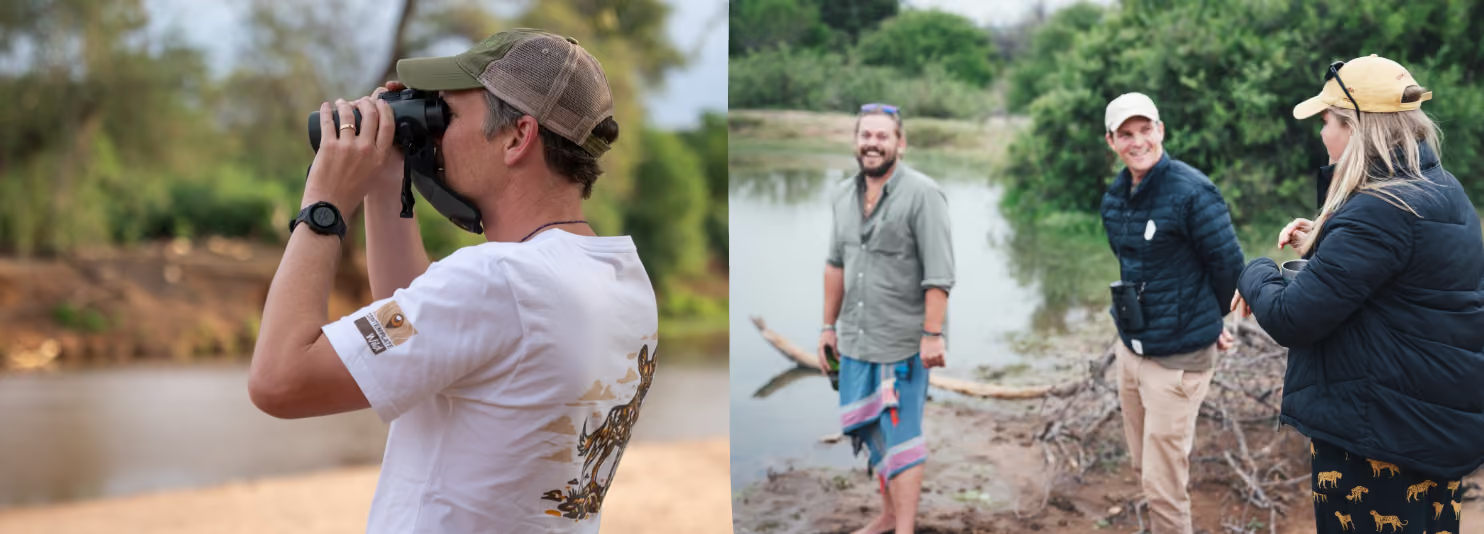
You know, there’s a couple of things with birding, one it was in me from when I was born, you know.
My My dad always had binoculars, was always looking bird.
Right now, he is moving towards seeing 900 species in Southern Africa, out of that 960-70 odd, you know, it’s it’s extreme.
So, I was always just into it.
But but what I realized reading this book, do you know what actually drives me is is the competition of it.
So, I do love watching birds, I watch birds out my window when I’m at my laptop, I watch birds out my garden, I look at birds as I’m driving, but really what drives me is the is the is list, is making lists, is trying to see new birds in new places, trying to find new birds.
It is the thrill of the chase, it is I go and I look for birds that I haven’t seen before, that gives me a thrill, it gives me a thrill to make a list to see new birds.
And there’s definitely a competitive thing about it.
And, you know, birding has gone crazy in the world.
It is really expanded dramatically in the last 15 years.
Mhm.
And I've seen it with my own friends, group, people that I grew up with, how popular it is in South Africa with more and more younger younger younger people.
It was always seen as a old-timer's thing.
Mhm.
Um we are fiercely competitive, we do it a lot, wherever we go we look at birds.
Now, I’m there are different levels of twitching and how serious you are about it, but definitely the epiphany when I wrote read this book was, "Yes, you are driven, Brett Horley, by the the fact that you want to see new things and make lists," you know, for me.
But I Radical birding.
Yeah, extreme birding.
It is, it can be, man.
I just did a trip in in the Lower Zambezi Valley in in December.
That was extreme birding.
You got to be pretty extreme to do what we were doing, but it was incredible, absolutely incredible.
I'm still at like Ground Hornbill, African Jacana.
You do you do you have a running tally of how many birds you've seen?
In Southern Africa, yes, I do, I do.
Do you have a number off the top of your head?
Uh 725, I think 725.
The birding king.
But it gets hard, it gets hard, yeah.
Okay, what's a bird you haven't seen yet that's on your list that you're after?
You know, so in December we went for this bird called the African Pitta.
It was on the the bird book of the first book I ever had, Ken Newman, when I was young.
It is absolutely beautiful, they're extremely hard to find in Southern Africa.
Uh the pitta family all over the world are revered.
Mhm.
Um so, I haven't really had time to process since December when we went and found this bird and saw this bird a few times and we missioned there 120° Fahrenheit heat, it was it was extreme.
There's there's a Egyptian vulture has come into Southern Africa a few times, they they were historically quite common here, but extinct as a breeding species, and I've I've chased and gone after that bird five or six times in Kruger Park when they've rocked up, and missed it every time.
So, that's probably a bird that gets me.
I haven't actually seen them in other parts of Africa or the world where they're found throughout, India, all kinds of places, so that's probably the bird that I want to see.
And I have got more into birding all over the world, and outside of Southern Africa as well.
Wow, wow.
But that's next level a secret, but I don't want you to tell anyone that.
Okay, turn off the mic for this.
I prefer birding by myself than with other people.
Like, it's actually weird.
Why is that?
I don't know, I guess I've just find it more satisfying personally, you know.
I have guided birding trips, I I have a bunch of friends, my dad, his friends, we bird, we've birded throughout Africa, in some incredible places.
When we went up to Zim we realized, "Okay, this is the third time we're flying to Harare for a birding trip in the last five, seven years."
But I like, you know, cruising with my wife and kids in the park and just looking at some birds and just sitting in my garden looking at some birds.
I I don't really go anywhere without binoculars, ever.
Yeah, it sounds like a fun objective.
You're going to X place to see Y bird.
It's not just like, "Let's go in the woods and wander around."
It's like a mission, almost.
That maybe is what compels you to go out there on these birding trips, these extreme birding trips.
No, it is, and they are extreme.
We go on a birding trip, you come back, you're finished.
You've traveled a lot, you've you're sunburned, you're dehydrated, your feet are sore, but it takes us to incredible places, places where sometimes it needs tourism, it needs the tourism buck, and places which need to be protected, mhm you know.
These are the places where you start going to for look to look for specific species, so I love the fact that it takes us to these wild places.
And we sit around the fire and have a laugh in the evening, and we have incredible memories of these journeys, nothing to do with the birds.
When we start talking about those trips, it's about the, you know, the heat or when we got stuck in the mud or when we missed the flight or, you know, those are the memories we actually have.
Mhm.
The three-and-a-half-hour bumpy road.
Yeah.
Okay, I'm going to put you on the spot real fast.
Could you give us a bird call of any kind?
Yeah.
I wish I was better at bird calls, one of my- Yeah, yeah, and I practice a lot, but I'm tone deaf.
We'll ask Chloe if she can uh recognize, but I need to do a hard one.
Okay, well we can save this for the birding podcast, cuz clearly you need a full episode based on birding.
your favorite lodges cuz that's like picking your favorite child.
But I'm curious to know like what's one place that really resonated with you?
A lodge or camp?
Maybe it's the setting, maybe it's the hospitality.
I mean, we could take this question in any direction you want to go cuz I know it's a loaded one.
Yeah.
But I'm just curious.
Yeah.
You know, I think I get asked the question quite often.
I'm going to go down the route of like places that have really resonated with me along the way cuz it changes.
You know what I said 7 years ago and 5 years ago and it's not because the other places are better.
It's just like this.
You go to a place and it resonates with you.
You know obviously historically in Zimbabwe Lake Kariba house boats you go on a house boat on Lake Kariba Zim you know 20 30 years has gone through some turmoil that was the ultimate.
I grew up I went there twice as a family and you you know for me and then you know disclaimer but if I can bird fish and look at animals then that's the place for me that that's that a lot of these places that I talk about have those three things and I like to be
fishing for tiger fish with my boss and a beer and an elephant and and that if I can do that dream
yeah it is man and and that is that is you know where so
how spot on Lake Kariba You know, northern Botswana I I love I love every time I go there.
I love the diversity where you were now in the Delta.
So, Selinda Game Reserve in the Northeast always had my heart and for a long time I said Selinda, Selinda, Selinda.
I really did for a long time.
I like the diversity of species up the things these ecosystems also changing all the time.
You know, the dynamics of them and the water and the droughts and the heavy rainfall years.
So, you can have very different experiences seven years apart in two exact same places.
Selinda.
But the Delta, you know, when I go to the Delta now, I'm at a water-based camp which has the opportunity to do game drives.
If I can do a game drive in the morning and go on aluminium boats in the afternoon, I'm very, very happy.
I like to do a long game drive in the morning and then relax and then go on the boat for an hour or two in the afternoon.
Whether you're fishing or not, just cruise a gin and tonic those that sunset going over the channels and then I yeah you know Bisate is Bisate but that Bisate like when I when I first went there it really did get me.
The people are incredible.
I love the smell.
I love the feeling of it.
It's very high altitude for the gorilla tricks.
The place is very special.
My soul lives in the Timbavati
down the road from me and my soul lives there and my soul lives in Kruger Park.
We went now on Kruger this weekend playing cricket in and golf at Skakuza and we driving back.
There's four of us.
We always drive up through the park.
We stop at this picnic site.
All four of us have been to the most incredible places in Africa.
But
that's your spiritual home
100%.
Yeah.
And you know I drove through yesterday.
I got home and I said to my wife and my girls like I said to Kate, "When are we going to Kruger?
We need to make a plan.
I can't go the next two months without going back in there with you guys."
So I'm happy there.
Wow.
All right.
Well, thanks for answering.
That's a big question.
I know.
I want to go to all these places.
So, send me on the next itinerary.
Okay.
I'm happy, man.
I think you should come to Malawi with us.
I would love to sign me up.
Sign me up.
Chloe did this dream itinerary.
Uh, you know, we've shared all our team members dream itineraries.
We each came up with a dream itinerary.
They're super cool on our website.
Awesome to go.
So, we each came up with our ultimate safari.
So Chloe’s around Timbavati
No, I uh it was um Ruaha and Selous in Tanzania where I have have never been.
Selous is now called Julius Nyerere.
Uh I have not been to those two parks.
Two of the two iconic probably the top iconic parks that I haven't been to.
So I really want to go there.
And yes, you can fish, you can walk.
There was a combination of super ultral lux and a very basic camp.
Checks all your boxes.
Yes.
And a bit of walking, you know, which was No, I'll send you a fake email and go click on hers.
It's super cool.
Yours was uh
Gorillas, Grumeti and Pemba Island.
That's right.
Zanzibar at the end.
That's a fun question.
Everyone designed your dream safari days.
It's super cool.
And our whole team did them.
It's so awesome.
If you want safari inspiration, go go look at our team's dream itineraries.
Yeah.
My dream itinerary would include Magoebaskloof.
Where are we?
I'm going to have to practice that one with the BHS team right now.
Yeah,
we are at AfriCamps.
Cool.
Well, I'm going to deviate from the Safari Lodge question a bit.
I'm curious to know,
take a second to think about this one, but who's one influential person that was foundational to you?
Whether it was the beginning stages of your safari career or someone you met more recently, whoever comes to mind first, would you be willing to share that?
Yeah, definitely.
I mean, some of the names that are already mentioned, I kind of mentioned them for those reasons.
You know, a lot of people who really were instrumental in in in that career.
I think, you know, obviously the passion for nature comes from my from my father and, you know, grateful also for the encouragement to to do what I love, you know, and what I'm passionate about.
And doing what you're passionate about in life makes things pretty easy.
I had a premonition, you know, I I knew I wanted to be in the bush, no matter what that meant.
I dreamed of being a wildlife vet and all of these things along the way, but the opportunity like follow your dreams is a privilege sometimes, you know.
So, and then yeah, you know, these these guys that I mentioned, the Bruce Lawson's, the Bruce Mises, Quinton, Mike Cens, you know, there's lots, the little Tuckers, these guys had Cliffy Phillips had a had a big influence on my life as I as I went.
And you know, again, playing golf with with Neil White
on Friday evening.
He said something very good.
You know, uh we're on the last tea off there.
We've had a couple of beers.
We're hitting over the hippos and the big pond at Skukuza Golf Club.
And he said, you know, as a guide, you know nothing.
You only know what you've read in books and what other guides have told you.
I never came up with any of these stories myself.
This is not my knowledge.
I'm sharing somebody else's knowledge.
Sometimes I probably haven't done enough background work on it, but you know, everything that I know and the the factual knowledge that I guide with is other people's that's their knowledge that I took and all of these people have had an influence along the way.
Yeah.
Mhm.
You know, my wife honestly, you know, you want to get deep her encouragement and her support over the last 17 years has been instrumental like in me backing myself to do what we have done, you know.
Yeah.
Yeah.
And the freedom to do that and
Yeah.
So, we could chat all day, but before we wrap up this podcast, I want to do a fun activity.
I call it hot seat.
It's like a this or that series.
I have two minutes to ask you anything I want.
It's rapid fire.
First thing that comes to mind, system one, brain.
Are you willing to take a seat in the hot seat? 100%.
The theme of course is Safari, but I might throw a few other curve balls at you.
We'll see.
And this is also um quick thinking on my part cuz I only have about seven written, which is going to take us approximately 7 seconds.
So, let's see if I can do this on the fly.
Okay, I'll take it easy.
Are you ready here?
Let me start the timer.
Okay.
Okay.
All right.
First question.
Sunrise or sunset?
Sunset.
Coffee or tea?
Coffee.
What do you put in it
nowadays?
Only milk during the week.
Any other time?
Amarula.
Amarula.
Amarula.
Sometime even during the week.
Three parts.
Amarula
sometimes.
Yeah.
Boat.
Safari or bush plane?
Oh, safari.
Mhm.
I know.
Sometimes it's like impossible to answer that so quickly.
No.
No.
I don't.
Yeah.
That's my fun in airplanes.
Lots of them.
Lions or leopards?
Leopards to look for lines for mad action.
Crazy
one% of the time you look at them though.
Yeah.
Sun sunglasses.
I It has to be both.
I can't.
Yeah.
Not one or the other.
I'm not going anywhere without either.
Yeah.
Okay.
I couldn't.
Gorilla trekking in Uganda or Rwanda?
It's the same thing, man.
Yeah.
The gorilla trek is the same thing.
Yeah.
Yeah.
Okay.
Desert or jungle?
Jungle.
Zanzibar or Cape Town?
Cape Town.
Maasai Mara or Serengeti?
No, it's a big one.
It's a big one.
Can't
The people who don't understand the safari world are like, "Why is he so stoked on that?"
It's too much.
There's too much going on both reserves.
That's all right.
Yeah,
I'm out of questions.
Fishing or birding?
Birding.
Yeah, just
what's in
birding while fishing.
What's your go-to snack?
Biltong, biltong is life.
What kind?
Ah, it doesn't matter.
It's a very South African answer.
Oh, and look at that.
Our timer is done.
Well, thank you, Brett, for letting me ask you all those questions and having me on the podcast.
I know we're going to do this again, but I'm going to be in your position.
You're back in the posting posting spot.
Um, it was really fun to get to know you because there's a lot to learn from you and I'm here to glean all that knowledge.
So, this was a good excuse for me to double dip.
I'm visiting in person and we're cranking out a podcast so everyone else gets to learn, too.
Thanks so much for joining and any closing remarks.
No, it's epic.
It's epic to be with you.
You know, an experienced world traveler.
I really appreciate it.
We should do that again.
Yeah, let's do it.
We'll see you next time for more campfire conversations with Bradley.
Thanks for listening.
Thank you for joining us.
If you loved what you listened to, subscribe to our podcast and follow us online to get a closer look at the world we talked about today.
Give our guests a follow on social media via the links in the description to learn more about them and show support for the work they do.
Please reach out to let us know what you want to hear, who you want to listen to around a campfire, and what burning questions you have about life in the wild.
Catch you next time.
And until then, you can always find us in the bush.